Found*, wherever you are**.
A phone is a great tool, but your safety should not rest on it alone. If you want to be safer outdoors without paying a subscription, a Jikita beacon is a simple answer: it keeps emitting for months, whatever happens to your phone.
* Provided rescue teams know roughly where to start searching.
** In France, where rescue teams carry the detector.
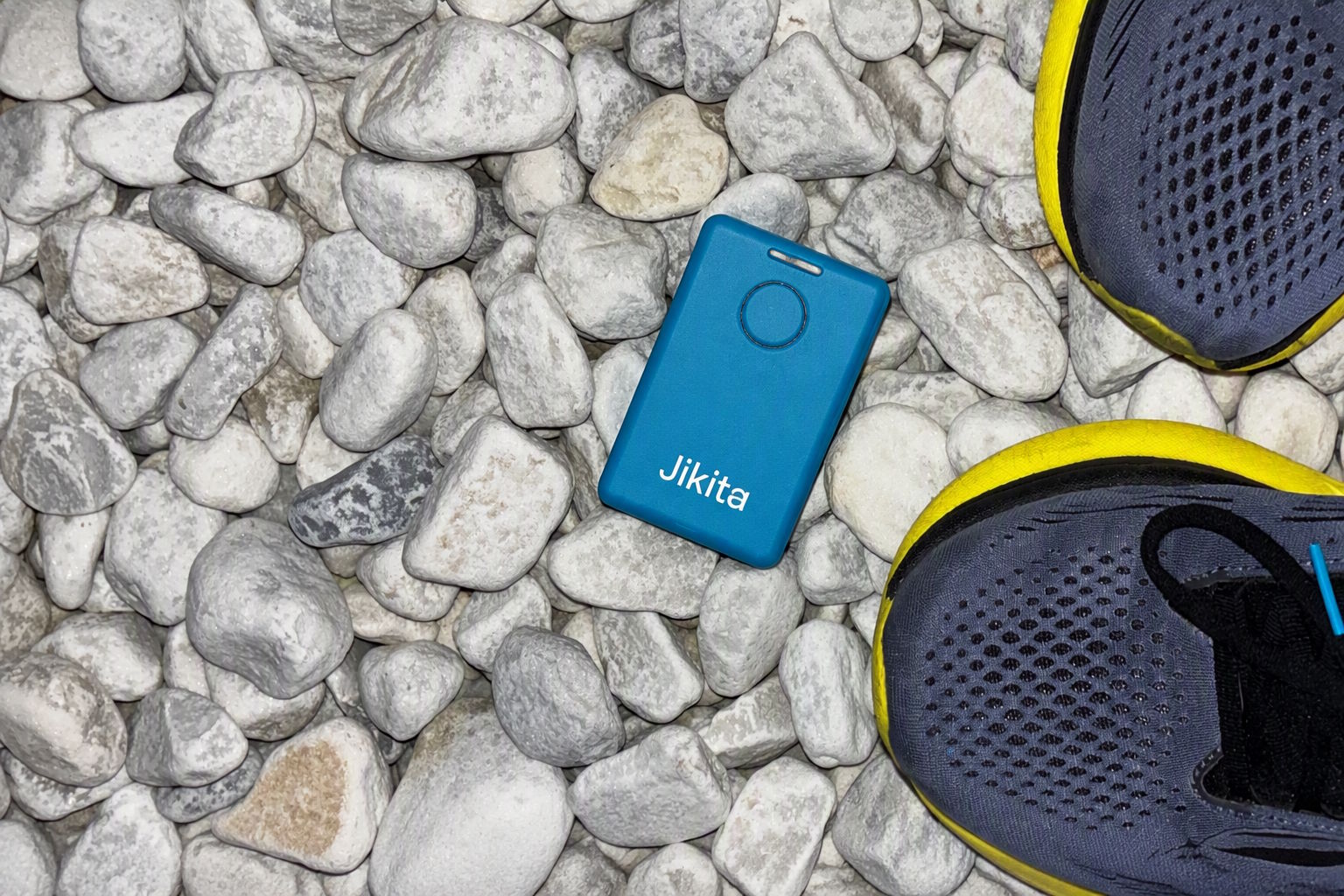
- €75No subscription
- 3 monthsOn one charge
- < 50 g85 × 55 × 7 mm
- IP65Rain and dust
Time is what rescuers are short of
A smaller search area
“Somewhere in the massif” is one search. “On the east flank, above 2,100 m, moving north-east ninety minutes ago” is another. The smaller the area, the sooner rescuers reach you, and the safer it is for them too.
Every hour counts
Often the longest wait comes before anyone realises something is wrong. Someone who told nobody where they were going may not be missed until the next day. A shared plan with a return time turns that silence into an alert within minutes.
Why “I’ll call for help” is not enough
No signal, because the gaps are where the terrain is difficult. A flat battery: at −10 °C a phone can go from 60 % to nothing in minutes. Or not being able to say where you are in a way that helps anyone.
Where the app stops
myJikita is free and covers a lot. All of it runs on your phone.
| Feature | With signal | No signal | Phone broken or battery flat |
|---|---|---|---|
| Live position to your contacts | Works | Held on the phone, sent late | Stops |
| SOS | Works | Queued until there is signal | Stops |
| Your track and planned route | Works | Recorded, sent late | Stops |
| Messages | Works | Queued until there is signal | Stops |
| Offline maps | Works | Works | Stops |
| A Jikita beacon | Broadcasting | Broadcasting | Broadcasting |
Everything myJikita does runs on the one object most likely to fail. That is not a flaw in the app. Phones are not rescue beacons.
How you are found, without your phone
- Continuously
1. Your beacon emits
A Jikita emits its signal on its own, all the time, independently of any network and of your phone.
- Up to 10 km
2. Rescue homes in
Rescue services with a detector pick the signal up and home in on it. Today, that equipment is carried on French rescue aircraft.
In France, a call is enough
In France, someone who cares for you calls 112. That is all they need: no app, no account, no console.
The PGHM is dispatched.
They pull your track and your planned route from the console.
If they are searching, the detector carried on the aircraft picks your beacon up from up to 10 km out.
- The detector is patented, carried on French Sécurité Civile and Gendarmerie rescue aircraft, and works offline and off-grid: up to 10 km range, 30 cm precision.
- The console is GDPR- and CNIL-compliant. Every lookup is authenticated and traced to the individual operator.
In France, any person equipped with a Jikita beacon can now be found by the PGHM following a call from a relative at 112.Outside France
We are working hard to convince rescue services outside France to adopt our technology. In the meantime, your contacts hold your live position, your track and your planned route, ready to hand to local rescue. What French rescue services also have, and others do not yet, is the detector carried on their aircraft.
French services equipped once enough people were carrying a beacon. Rescue organisations elsewhere know the technology.
It works without you
Roughly once every 10 seconds, a Jikita broadcasts who it is, its battery level, whether it is moving, the last position your phone gave it (if any) and how old that position is, and its state, including distress.
Being heard asks nothing of you. The beacon broadcasts whether or not anything has gone wrong: no button to reach, no phone to charge.
Distress is raised from myJikita: send an SOS and your beacon carries the distress state in the clear, in every broadcast.
- No screen.
- No buttons to learn.
- Three months on a charge.
A beacon you have to press is a beacon that assumes you can press it. A Jikita is heard either way.
Everyday
Green light, good to go
The light on the front of your Jikita is green: the battery is fine. That is the whole pre-trip check.
Red light, recharge it
The light turns red when the battery is low. Recharge it over USB before you rely on it.
Pocket it and go
That is it. Put it in your pocket and enjoy your day. It does its job without you.
With your phone and myJikita
These need your phone within Bluetooth range of the beacon, with myJikita running.
Beep
Find it at the bottom of a bag or under a seat. A beep raises no alarm and changes no state. It just makes a sound.
Radio check
Confirms the beacon can receive as well as transmit. Worth running once after pairing and once before a serious day.
Kept up to date
While an outing runs, the app hands the nearest beacon your position and the time, riding along with the positions you already send. No separate battery budget.
Who carries one
Mountaineering
Cold drains a phone battery fast. Carry the beacon on your body, not in the pack you might take off at a col.
Solo trail running
Light, fast and alone, with nobody beside you to raise the alarm. The beacon asks for nothing on the move.
Long hikes off-network
Days in places your phone cannot reach. The rescue teams’ detector picks up the beacon directly, whether or not your phone has signal.
Climbing and via ferrata
Both hands busy, and the phone in the lid of a pack you cannot reach. The beacon is on you, and it is already broadcasting.
What a Jikita is not
Not a satellite beacon
A PLB transmits to satellites and works anywhere with a view of the sky. A Jikita is found by the rescue teams’ detector within range of its signal, up to 10 km. It does not give global coverage, and today that equipment is carried only by French rescue services.
Not a people tracker
A Jikita belongs to one account, and pairing requires physically holding the button on the device. Nobody can claim a beacon they walked past, and nobody can tag you without you handling it yourself.
Not a substitute for telling someone your plan
It shortens the search. It does not start one.
Specifications
- Battery life
- 3 months on a charge
- Weight
- Under 50 g
- Dimensions
- 85 × 55 × 7 mm
- Water and dust
- IP65
- Radio
- Bluetooth, and LoRa 868 MHz
- Serial number
- Printed on the device and shown in the app
- In the box
- Jikita, USB charging cable, quick start guide
- Guarantee
- Two years from delivery, on top of your statutory rights
- Support
- At least five years, with free firmware updates
Jikita
“to find, to locate”
in Aymara, the language of the Bolivian high plateaus.
Get a Jikita
€75 incl. VAT
No subscription. The app is free.
Rescue teams will be equipped progressively. For now, only French rescue teams are equipped.
Questions
Is there a subscription?
No. The myJikita app is free, and a Jikita costs €75 including VAT. There is no subscription for the beacon.
Does it need my phone?
Not to be heard. Your phone is how you pair the beacon, check its battery, keep it supplied with your position and the time, and raise an SOS. The position a beacon reports is the last one your phone gave it, which tells rescuers where to start. The final search homes in on the beacon itself.
Does it work where I go?
It works where rescue teams are equipped. For now, only French rescue teams are equipped.
How is it different from a PLB or a satellite messenger?
Those transmit to satellites and work anywhere with a view of the sky. The myJikita app relies on your phone and on 4G and 5G coverage that keeps getting denser. The white areas that remain are where a Jikita matters: the beacon can still be found by rescue teams.
What happens to my position data?
Every party that can see a position, and under what conditions, is named in Who can see your position.